Back to the Threshold: Engineering Decisions are Economic Decisions.
It has been almost a year since I last posted here.
That was not the plan.

But like many engineers and engineering leaders, the work in front of me has had a way of consuming the time I intended to spend writing about the work itself. In some ways, that year away has helped clarify what I want The Innovation Threshold to become.
I don't want this to simply be a collection of articles about engineering, technology, or innovation. There are already plenty of places to read about new equipment, automation, AI, manufacturing technology, and the latest management ideas.
I am increasingly interested in something slightly different:
How do engineering leaders make better decisions?
Because engineering leadership is rarely just an engineering problem.
The Engineer's Changing Job
Early in an engineering career, success is often defined by technical competence.
Can you solve the problem?
Can you size the equipment?
Can you understand the process?
Can you develop the design?
Can you get the project installed and operating?
As your responsibility grows, the questions change.
Should we solve this problem at all?
Is this the right problem to spend money on?
Should we automate or add labor?
Should we add capacity or improve utilization of what we already own?
Should we replace an aging asset or continue maintaining it?
Which project should receive capital when five projects are competing for the same dollars?
Those are still engineering questions, but they are also economic questions.
And I don't think engineers spend enough time studying that side of our profession.
We Already Practice Economics
Most engineering managers are comfortable discussing Payback Period, Internal Rate of Return, and Net Present Value.
Those are important tools.
But economics extends much further into our daily decisions.
When we choose between competing capital projects, we are dealing with scarcity and opportunity cost. When we evaluate whether another production line is needed, we are making assumptions about demand. When we compare automation with additional labor, we are evaluating substitution. When we reduce work-in-process, shorten cycle time, or attack a constraint, we are working with concepts that connect operations, economics, and principles such as Little's Law.
We may not use those words in the meeting, but we are already using the ideas.
That realization has led me toward the next series I want to develop here:
Economics for Engineers
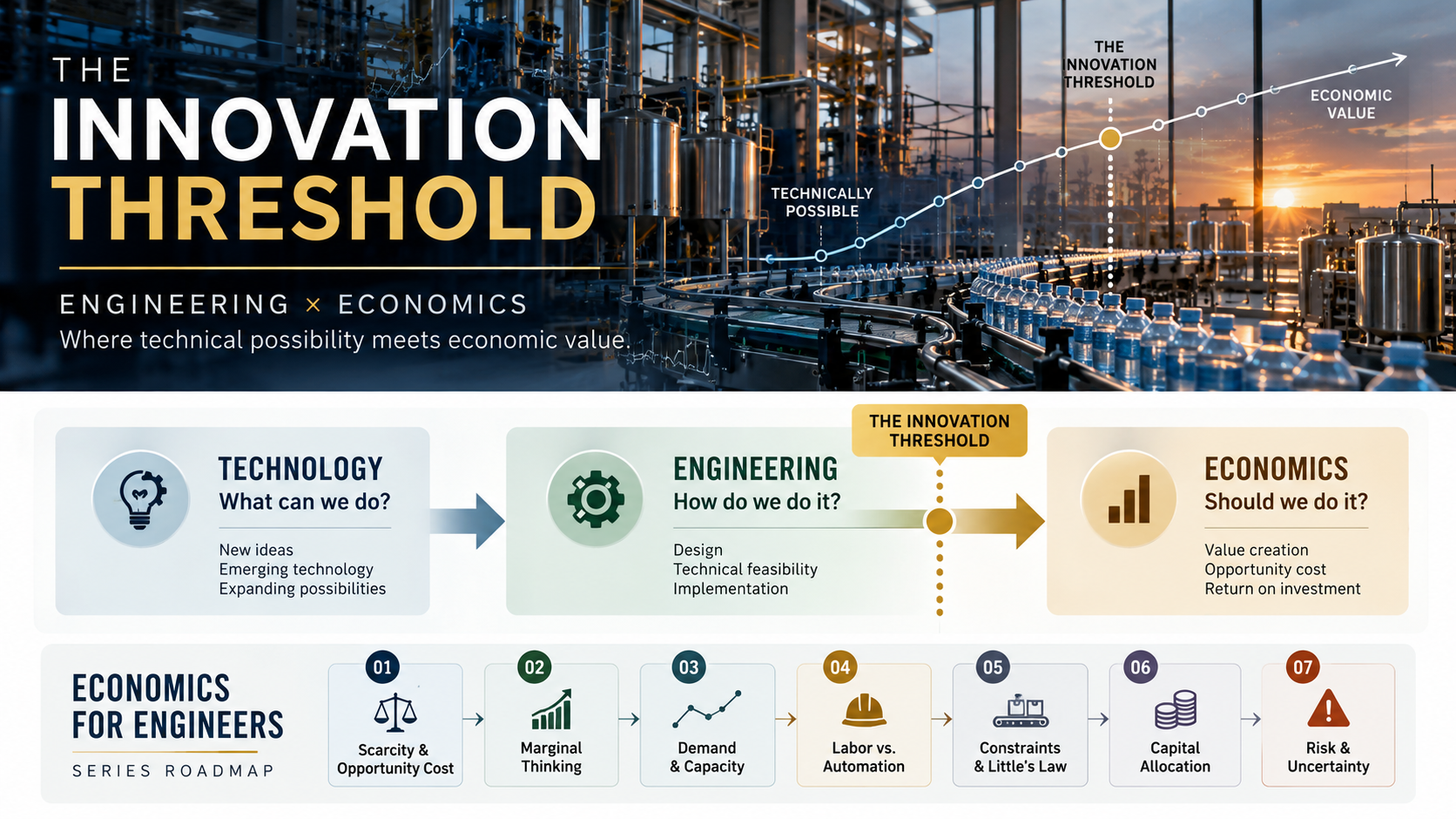
This will not be an economics textbook disguised as an engineering blog.
My goal is much more practical.
I want to take economic principles and put them into the context of the decisions engineers, engineering managers, operations leaders, and capital project teams make every day.
Topics I plan to explore include scarcity, opportunity cost, marginal analysis, substitution, demand, constraints, capacity, utilization, inventory, risk, and the economics behind capital allocation.
Some will connect directly to familiar engineering tools such as NPV, IRR, OEE, throughput, and Little's Law. Others may challenge the way we traditionally think about engineering decisions.
Because the technically best solution is not automatically the best investment.
The highest-speed machine does not necessarily create the most value.
Maximum utilization is not always the goal.
Automation is not automatically cheaper than labor.
Solving the largest engineering problem does not necessarily mean solving the most important business problem.
Those are the conversations I want to explore.
Crossing the Threshold
That brings me back to the reason I started The Innovation Threshold in the first place.
Innovation is not simply adopting new technology. There is a threshold between what is technically possible and what is worth doing.
Engineers operate around that threshold constantly.
1. Technology tells us what we can do.
2. Engineering tells us how to do it.
3. Economics helps us decide whether we should.
Over the next several posts, I want to spend some time at that intersection.
It feels like a good place to restart. Let me know your thoughts.